Cloud bills tend to creep up silently — and before you know it, you’re overpaying for unused VMs, oversized machines, or forgotten storage.
Having worked closely with cloud-native teams, I’ve seen how a few simple changes can lead to significant cost savings — without compromising on performance or reliability.
So I visualized the process.
Here’s a 5-step framework to help you optimize your cloud spend, with practical actions at every stage.
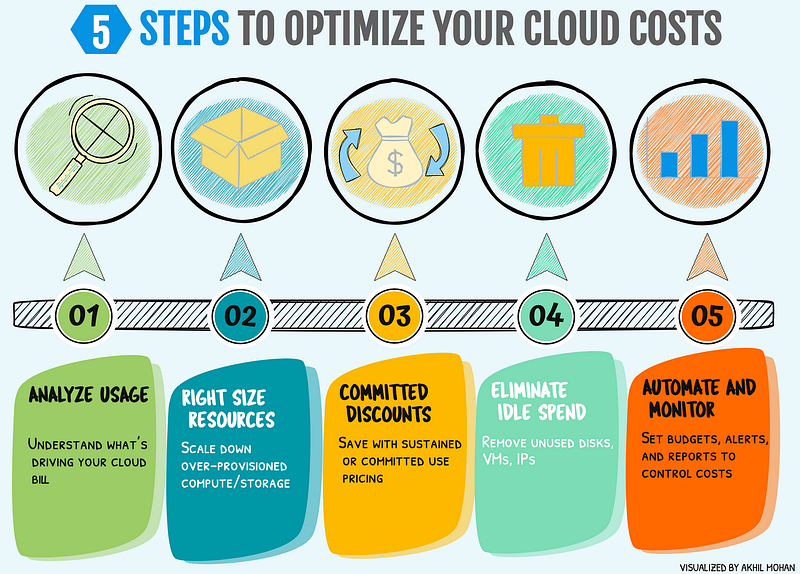
Cloud Cost Optimization — Visualized in 5 Practical Steps
The 5-Step Breakdown
1. Analyze Usage
Understand where your cloud costs are coming from. Use billing reports, BigQuery exports (in GCP), or AWS Cost Explorer to track usage patterns across services and projects.
Ask: What services are driving spend? Which projects or teams consume the most?
2. Right-Size Resources
Downsize over-provisioned instances, disks, and clusters. You don’t always need an n2-standard-8 for a dev VM — sometimes an e2-medium gets the job done. Use rightsizing recommendations from your cloud provider. Apply autoscaling where possible.
3. Committed Discounts
For workloads with predictable usage, use:
- Committed Use Discounts (CUDs) on GCP
- Savings Plans or Reserved Instances on AWS
- Azure Reservations in Azure
These offer discounts of up to 70% for steady-state usage. Can be scoped per project or per org depending on billing strategy.
4. Eliminate Idle Spend
Remove:
- Unattached persistent disks
- Unused static IPs
- Zombie instances and load balancers
Enable reaper tools or scripts to flag & clean up idle resources. Schedule dev environments to shut down outside working hours.
5. Automate & Monitor
Set budgets, alerts, and anomaly detection tools. Enable dashboards to surface spend by service or project.
Tools that help:
- GCP Budget Alerts + Looker dashboards
- AWS Budgets + CloudWatch
- Third-party tools like CloudHealth, Finout, or Harness CCM
Make cost visibility a daily part of dev & infra reviews.
Conclusion
Cloud cost optimization isn’t about cost-cutting — it’s about smart architecture, proactive visibility, and clean operations.
If you treat it as a regular practice — not just an end-of-quarter panic — you’ll save money, reduce waste, and build a more efficient cloud footprint.