Introduction: Kubernetes can seem intimidating at first. Pods, clusters, rolling updates, self-healing — it’s a lot.
So I thought: what if we explain Kubernetes like we would explain a restaurant?
Because, in many ways Kubernetes is like a restaurant manager. It takes care of your orders (apps), tables (nodes), chefs (containers), and makes sure everything runs smoothly — even during the dinner rush.
Here’s a fun, visual breakdown of how Kubernetes works — as if you were running a cloud-native restaurant.
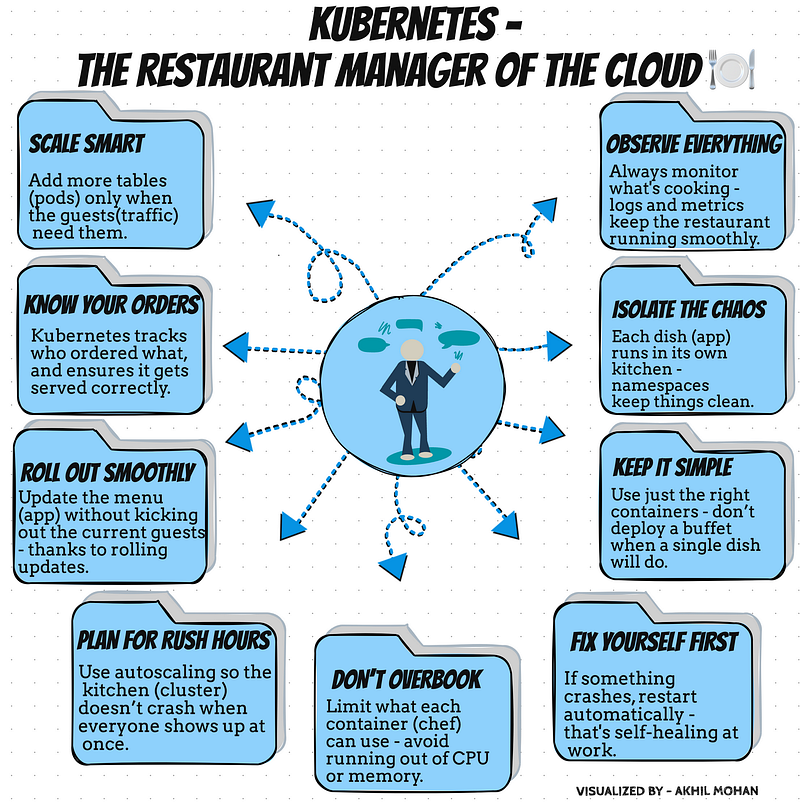
Orchestrating Cloud Workloads, One Pod at a Time 🍴🐳
The 9 Kubernetes Concepts — Explained Like a Restaurant:
1. SCALE SMART
Add more tables (pods) only when the guests (traffic) need them. This is horizontal scaling in action. Kubernetes watches demand and adjusts the number of pods accordingly.
2. KNOW YOUR ORDERS
Kubernetes tracks who ordered what and ensures it gets served correctly. That’s service discovery and internal routing — making sure every request reaches the right container.
3. ROLL OUT SMOOTHLY
Update the menu (your app) without kicking out the current guests. This is where rolling updates come in — your app stays available while new versions roll out behind the scenes.
4. PLAN FOR RUSH HOURS
Use autoscaling so the kitchen (cluster) doesn’t crash when everyone shows up at once. Kubernetes monitors metrics and scales resources when demand spikes.
5. DON’T OVERBOOK
Limit what each container (chef) can use — avoid running out of CPU or memory. That’s resource requests and limits, which keep your cluster healthy.
6. FIX YOURSELF FIRST
If something crashes, restart automatically — that’s self-healing. Kubernetes watches pod health and replaces anything broken.
7. KEEP IT SIMPLE
Use just the right containers — don’t deploy a buffet when a single dish will do. Focus on microservices and clean container design.
8. ISOLATE THE CHAOS
Each dish (app) runs in its own kitchen — namespaces help separate workloads. Great for organizing environments (dev, test, prod) or teams.
9. OBSERVE EVERYTHING
Always monitor what’s cooking — logs and metrics help keep the restaurant stable. Tools like Prometheus, Grafana, and Cloud Logging make sure nothing burns.
Conclusion:
Kubernetes might sound complex — but it’s really just a smart restaurant manager.
When you break it down into daily life metaphors, everything clicks: scaling, updating, healing, routing, monitoring.
I hope this visual helped you look at Kubernetes differently — with a little less fear and a lot more fun.