Intro:
Most people think of Terraform as just writing some.tf files and running apply. But in reality, Terraform is a full lifecycle — from writing infrastructure as code to managing state, observing deployed resources, and improving architecture continuously.
To make this more approachable, I visualized Terraform’s lifecycle as a simple 6-step loop — with its core principles at the heart of it.
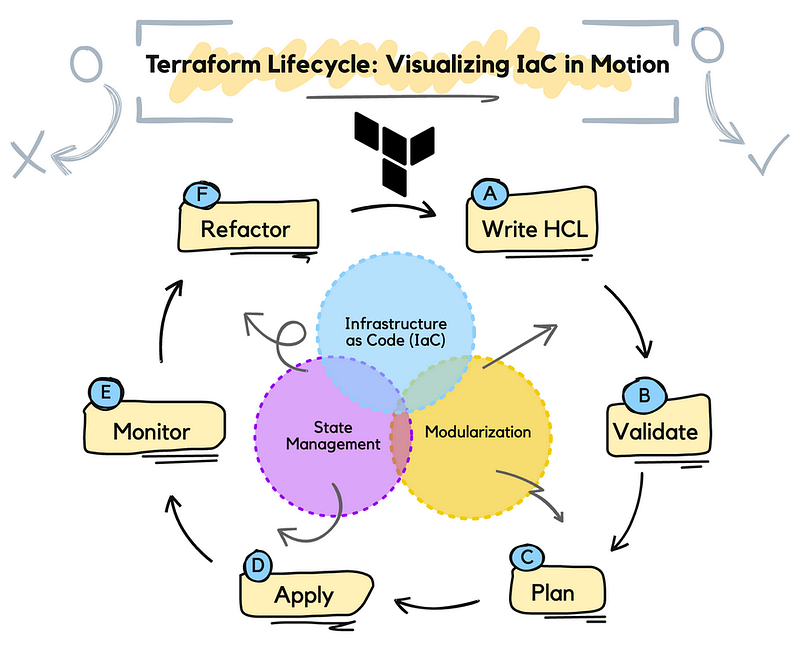
Terraform Lifecycle — Visualizing IaC in Motion
The 6-Step Terraform Loop:
Write HCL
Terraform starts with code — human-readable.tf files written in HCL (HashiCorp Configuration Language). Here’s where we define providers, resources, variables, and modules.
Validate
Run terraform validate to check syntax and basic logic. This helps catch simple issues early before moving to planning or applying.
Plan
terraform plan gives you a preview of what will happen before anything is deployed. It compares your desired state (in code) with the real state (in.tfstate) and shows what it intends to add, update, or destroy.
Apply
This is where the magic happens. terraform apply executes the changes and updates real cloud infrastructure based on the planned blueprint.
Monitor
Post-deployment, your infrastructure should be monitored. Track metrics, logs, and potential drift using tools like CloudWatch, Prometheus, GCP Monitoring, etc.
Refactor
No infrastructure is perfect the first time. Refactor modules, simplify code, and improve structure based on feedback or growth. Then the loop begins again!
Core Principles That Drive Terraform
These sit at the heart of the lifecycle and shape how Terraform works behind the scenes.
Infrastructure as Code (IaC)
Write, version, and audit your infrastructure using code — just like you do for application logic.
Modularization
Use modules to avoid repetition, enforce standards, and keep your Terraform code reusable and clean.
State Management
Terraform uses.tfstate files to keep track of what it has provisioned. This state is critical — it’s how Terraform knows what exists and what needs to change. Using remote backends and locking ensures collaboration at scale.
Conclusion
Terraform isn’t just a one-time deployment tool — it’s a structured lifecycle. When you treat it that way, your infrastructure becomes more stable, scalable, and collaborative.
If you enjoyed this visual walkthrough, follow me for more simple breakdowns of complex cloud concepts — with sketches that tell the story better than words alone.