Introduction
GenAI isn’t just a buzzword anymore — it’s a full-blown engineering cycle. But with so many moving parts, teams often find themselves confused: “Where do we start?” or “What happens after model deployment?”
To make this lifecycle easier to understand and remember, I visualized it using a Ferris Wheel 🎡 — because, just like GenAI, it goes full circle!
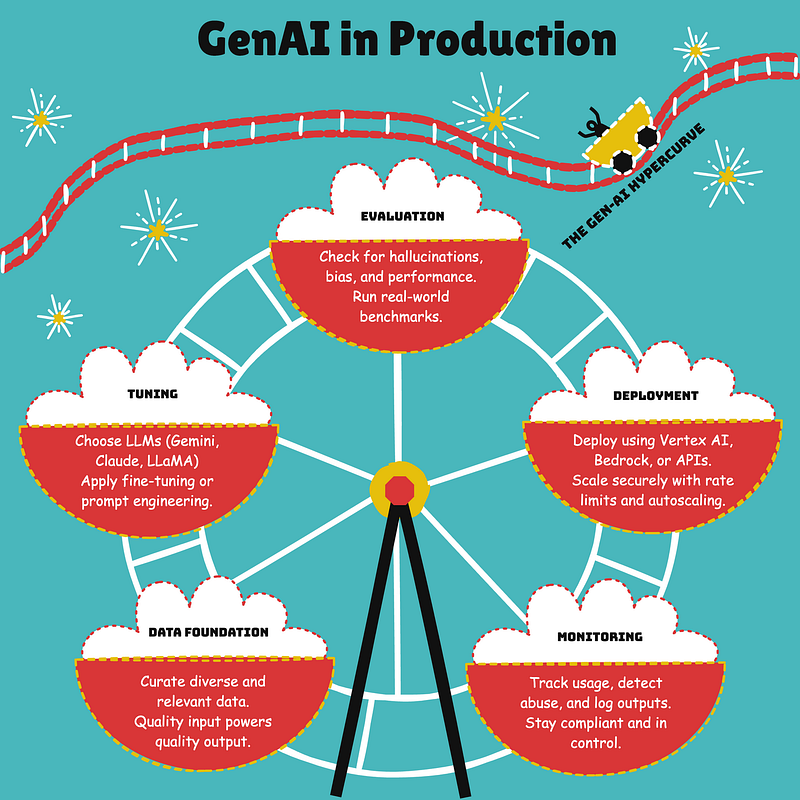
Visualizing the GenAI lifecycle like a Ferris wheel — every phase is part of a continuous ride.
Why a Ferris Wheel?
Each compartment of a Ferris wheel represents a phase in the GenAI production cycle. As the wheel turns, you go from data prep all the way to monitoring — and then you loop back, learning and improving.
Let’s step into each “compartment” of this journey:
1. Data Foundation
The ride begins here.
Curate diverse and relevant data. Quality input powers quality output.
This stage sets the tone for everything else. Without a rich, clean, and representative dataset, the model will struggle to generalize effectively.
2. Tuning
Choose LLMs (Gemini, Claude, LLaMA). Apply fine-tuning or prompt engineering.
Now, pick your base model and shape it to your needs. Whether it’s parameter-level fine-tuning or smart prompting, this is where GenAI begins to reflect your domain.
3. Evaluation
Check for hallucinations, bias, and performance. Run real-world benchmarks.
Before you deploy anything, validate it thoroughly. Simulate user queries, test edge cases, and ensure the model behaves responsibly under pressure.
4. Deployment
Deploy using Vertex AI, Bedrock, or APIs. Scale securely with rate limits and autoscaling.
Time to go live! But deployment isn’t just about hosting — it’s about serving responsibly. Add observability, autoscaling, and API rate limiting to keep things smooth.
5. Monitoring
Track usage, detect abuse, and log outputs. Stay compliant and in control.
Production isn’t the end — it’s the beginning of learning. Capture logs, monitor outputs, and detect policy violations early. AI should evolve responsibly.
Closing Thoughts
Whether you’re building GenAI apps in startups or large cloud environments, this lifecycle matters. It helps shift focus from “just build it” to “build it well, and build it sustainably.”
And just like a Ferris wheel… when you get off, you’ve got a better view.